Two districts, one page
We have combined Woden Valley and Weston Creek because each is small beside the larger districts, and a page for each would have little to say that is both different and true. They do not have much in common, though. ACT Planning's district profiles, tabulated on the Gungahlin profile page, give Weston Creek a low density share of 81 per cent. They give Woden Valley a higher density share of 17 per cent. We do not have the 2017 population of either district from a verified source, so we do not state it. We also do not have the age of the housing, so this page does not guess.
What those two shares suggest is that the scaffolding work in each district may be of a different kind: house jobs in one, a mix that includes taller buildings in the other. If you are in Weston Creek, read the section on houses. If you are in Woden Valley, read the section on higher density buildings. Both share the sections on power lines, winter and what to ask.
The ACT in context
Put the two districts against the territory as a whole. The Australian Bureau of Statistics' snapshot of the ACT in 2021 gives 454,000 usual residents, up from 397,000 in 2016. Of the almost 175,000 occupied private dwellings, 63.2 per cent were separate houses, down from 67.0 per cent in 2016, and 19.4 per cent were flats or apartments, up from 15.0 per cent. The median age was 35.
| Measure | Where it applies | Figure |
|---|---|---|
| Low density share | Weston Creek | 81 per cent |
| Higher density share | Woden Valley | 17 per cent |
| Separate houses | ACT, 2021 | 63.2 per cent (67.0 per cent in 2016) |
| Flats or apartments | ACT, 2021 | 19.4 per cent (15.0 per cent in 2016) |
| Median age | ACT, 2021 | 35 |
The trend in the ABS snapshot is the interesting one for scaffolding. The share of flats and apartments in the ACT rose over five years while the share of separate houses fell. That may point to more work on taller buildings over time, though the snapshot is for the whole territory and says nothing about either of these districts. Region Canberra, citing ABS data, reported in January 2026 that ACT total dwelling approvals fell 7.7 per cent in trend terms, and did not split them into houses and apartments, so we do not predict the pace of new building in Woden Valley.
Weston Creek: the house job
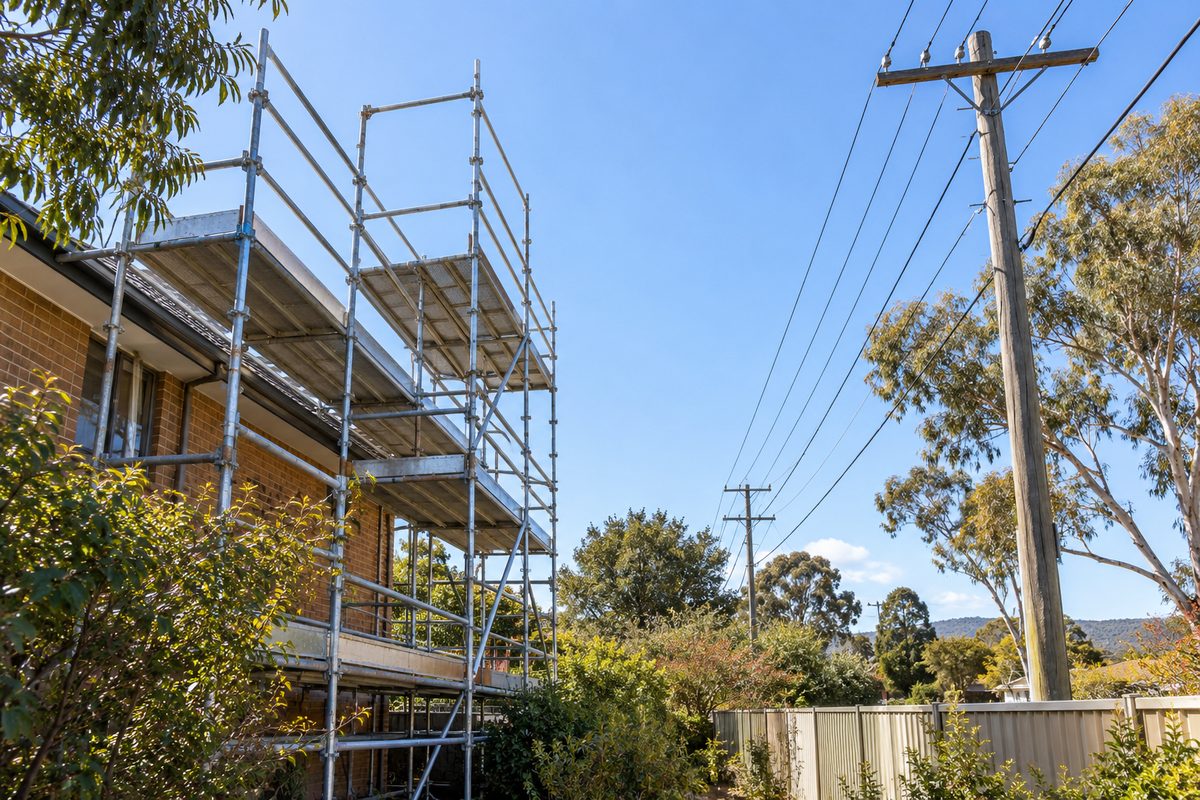
In a district that is 81 per cent low density, much of the scaffold work may be house work such as re-roofing, gutters, painting, repairs or extensions. The first question is how high. In the ACT a high risk work licence is needed where a person or object could fall more than 4 metres from the platform or the structure, and Safe Work Australia's guide gives a small frame scaffold for eaves or ceiling work as an example where it is not. The scaffolder measures and decides. Ask which class of licence the erector holds and for the licence number; most local scaffolders do not publish them.
Think about the front boundary as well. If the scaffold or its materials will go on the nature strip, the ACT process we found is the Public Unleased Land Act 2013, administered by the Public Land Use Team (02 6205 8794). The ABLIS entry for approval for works on or using public unleased land says to apply fourteen working days before starting. Scaffolding is not named on the page, so the careful wording is that it is likely to need approval, and you should confirm with the team.
Woden Valley: taller buildings and shared sites
Where there is a higher density share, expect some jobs on buildings with several owners or occupants, and some on structures that are taller than a house. The same 4 metre line applies, but it is more likely to be crossed, which means the erector is more likely to need a licence and the scaffold is more likely to need a handover inspection and a plan. Safe Work Australia's guide says for more complex scaffolds a plan should be prepared by a competent person. The commercial scaffolding page describes what building managers usually ask for, from covered walkways to hoists.
On a building with a body corporate or a manager, the first call is often not to the scaffolder. Ask who has authority to approve the work, what access the building's residents need during it and who will receive the handover paperwork. If the scaffold passes over a footpath, a walkway may be needed, and the footpath is public land. Do not assume an ACT hoarding standard exists, because we did not find one, and ask the Public Land Use Team what it wants to see.
Handover and inspection on a taller job
The longer and taller the scaffold, the more the paperwork matters. WorkSafe ACT's alerts say a scaffold should be inspected before first use, after a severe storm, after repairs and at intervals not exceeding 30 days, and a scaffold tag should be in place and current. Safe Work Australia's guide says a competent person gives written confirmation that construction is complete before a high risk scaffold is used, and sets out an example handover certificate. A general ACT requirement for that certificate is not verified, so ask for one anyway, and keep a copy where the building manager can find it. If residents or visitors pass the scaffold, ask whether the base of it is fenced or covered, and who checks that after a storm.
Power lines on both sides
Whether the job is a house or a building, check for overhead lines before the scaffold goes up. Evoenergy's scaffolding near overhead powerlines gives a 4 metre approach distance for metallic scaffold, and says to contact Evoenergy before work starts if that cannot be kept. Inside that distance the erector must be Evoenergy-accredited. For a hoarded scaffold, meaning one covered in sheeting or boards, it gives clearances of 1.5 metres from low voltage lines and 2.0 metres from 11 kV to 22 kV lines horizontally, and 2.4 metres vertically, with a safe work method statement and tiger tails. Treat lines as energised. Evoenergy's emergency number is 13 10 93 and the general line is 13 23 86. WorkSafe ACT's own page gives 4 metres for metal and 1.5 metres for timber, and we cite Evoenergy for network clearances.
The cold months
We have no weather record specific to either district. The Canberra Airport figures from the Bureau of Meteorology show 636.7 millimetres of rain a year and a mean minimum of 0.1 degrees Celsius in July, and the ACT climate guide says the frost risk has typically ended by the last week of October. Frost and short days slow the trades, and a slower job holds the scaffold longer. Ask the scaffolder what the base hire period is, what the weekly extension is and how a lost day is counted, and read the hire length guide before you agree.
Questions to ask in either district
- How high is the work, measured, and does the scaffold cross 4 metres?
- Which class of licence will the erector hold, and what is the number?
- Does anything sit on the nature strip or footpath, and who has asked the Public Land Use Team?
- Where is the nearest overhead line, and has the scaffolder spoken to Evoenergy if it is inside 4 metres?
- Who inspects the scaffold, and when is the first inspection after handover?
The inspections guide explains the tag and the 30 day interval, and the licence page lists the class names and the regulator's contacts. Local scaffolders are concentrated in Hume, Fyshwick and Queanbeyan, so a job in either district is likely to be served from outside it.
What this page cannot tell you
It cannot give the population of either district, because we did not verify it, or the age and condition of the housing. It cannot say what a typical job costs, and it gives no prices. It cannot tell you whether your building falls in the low density or higher density group, or whether your scaffold will cross 4 metres, which depends on the job. The ABS figures are for the whole ACT, not for these districts. Check the current rules with Access Canberra, WorkSafe ACT, Evoenergy and the Public Land Use Team.
Check the current rules before you rely on this
This page describes Woden Valley and Weston Creek, what the district density figures suggest and the licence, public land and power line rules that apply to scaffolding there. It describes the rules in general terms as they stood in October 2026. Standards, forms, thresholds and fines change.
The authoritative sources are ACT Planning, Gungahlin district profile, ABS, snapshot of the ACT 2021, Region Canberra, building approvals (January 2026), WorkSafe ACT, scaffolding, Evoenergy, scaffolding near overhead powerlines and ABLIS, approval for works on or using public unleased land (ACT). Where anything here differs from those sources, they are right and we are not.
We are not scaffolders, engineers, regulators or lawyers. For what applies to your job, ask the scaffolding contractor, WorkSafe ACT (13 22 81) or, for work on public land, the ACT Government Public Land Use Team.
Accurate at the time of writing, October 2026. Always check the source before relying on it.