The short version
The nature strip is Territory property, and the ACT handles works on it through the Public Unleased Land Act 2013. The agency is Transport Canberra and City Services, through its Public Land Use Team. Scaffolding or materials on a nature strip or footpath is likely to need approval, and the team asks for applications 14 working days before work starts. No ACT page found names scaffolding or hoardings, so the careful position is to ask the team before the scaffold is booked. Overhead lines are a separate question for Evoenergy, and a registered heritage place is a third.
Why a nature strip is not your land
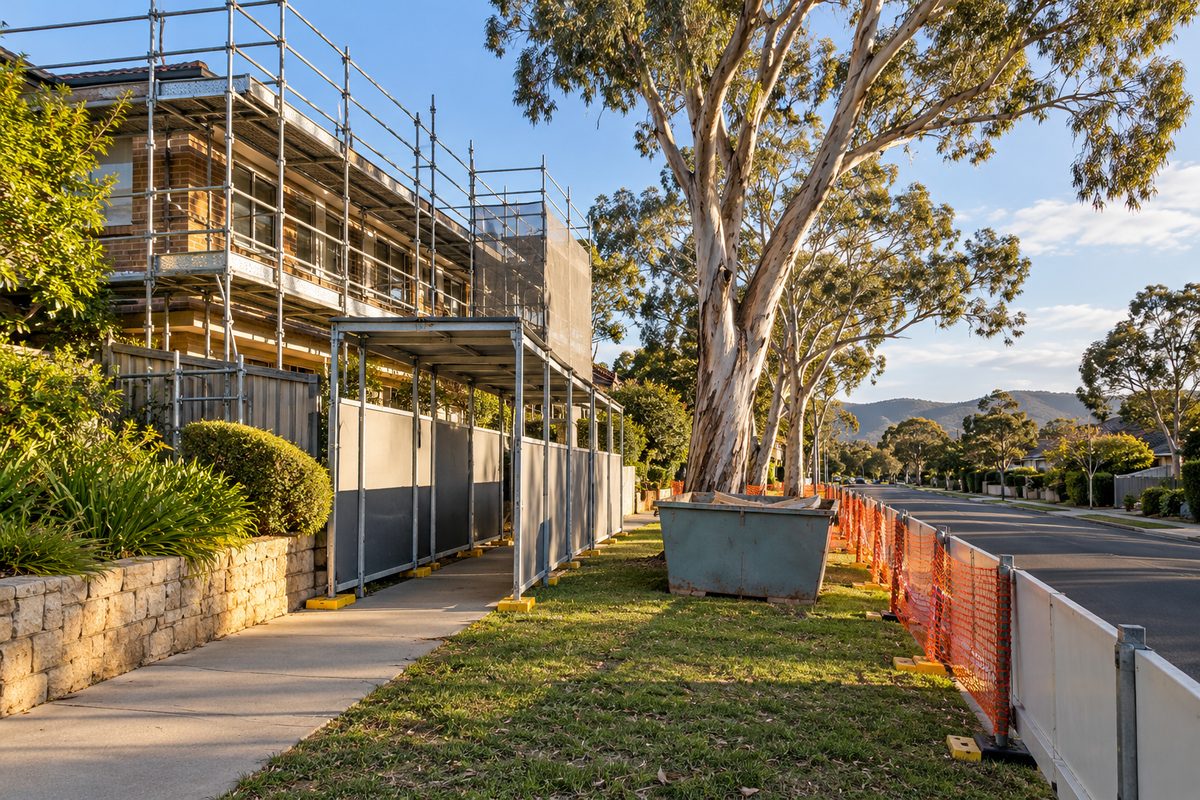
The ACT's business approvals listing for approval for works on or using public unleased land says the approval is needed to undertake works on, or occupy, unleased public land. It states that nature strips are Territory property, and that construction work and interfering with Territory property are covered. A scaffold standing on the verge, a covered walkway over the footpath or a pile of materials on the grass all occupy that land, whatever the building behind them is doing.
The Public Land Use Team is at GPO Box 158, Canberra ACT 2601, on 02 6205 8794 and [email protected]. The listing describes the application as one made 14 working days before commencement, with an authorised temporary traffic management plan needed before works that interfere with Territory property. Fees are set by a legislative instrument and the amounts were not shown on the page, so ask the team for the current figure.
What the approval pages ask for
The listing names two forms, a Public Unleased Land Permit application for commercial and municipal use, and a Nature Strip Development Application. Which one fits a scaffold depends on the arrangement, and the team decides. A separate ACT listing for the Public Unleased Land Permit covers activities that exclude some or all members of the public from using the land. Its listed examples include a construction skip on a footpath, which is the closest example to a scaffold or a covered walkway. Permits can carry conditions, such as financial assurance.
The same listing does not name scaffolding or hoarding. This is the gap in the research behind this page: no ACT Government page was found that says in terms what a scaffold on a footpath or verge needs, and no ACT hoarding standard or fee was found. Nothing here states one.
Where a scaffold stands and what to ask
| Situation | The question to ask | Who to ask |
|---|---|---|
| Scaffold wholly inside your block | Whether any part, such as a base plate, ledger or brace, overhangs the boundary onto the verge. | The scaffolder, then the Public Land Use Team if in doubt. |
| Scaffold standing on the nature strip | Whether approval is needed for works on or using public unleased land, and how long it takes. | Public Land Use Team, 02 6205 8794. |
| Covered walkway or barriers over the footpath | Whether a permit for an activity that excludes the public applies, and whether a traffic management plan is needed. | Public Land Use Team. |
| Skip bin or stacked materials on the verge | Whether a Public Unleased Land Permit is needed. A skip on a footpath is a listed example. | Public Land Use Team. |
| Overhead lines near the scaffold | Whether the 4 metre distance for metallic scaffold can be kept, and whether Evoenergy must be contacted. | Evoenergy, 13 23 86. |
| Heritage registered place | Whether the block is on the Heritage Register and whether fixing to the building needs input. | ACT Heritage Council. |
Who applies is a matter for the quote. The scaffolder or the owner may apply, and it may be priced as an extra. Ask, and get the answer in writing, with the lead time. A booking made inside the 14 working days may leave too little time for approval, so ask early.
Working near overhead lines
Evoenergy's scaffolding near overhead powerlines sheet says to keep 4 metres from overhead lines for metallic scaffold. If that distance cannot be kept, contact Evoenergy before work starts. A business erecting or dismantling a scaffold inside the 4 metre distance must be Evoenergy-accredited, with workers authorised as Supervised Workers. Hoarded scaffold clearances are 1.5 metres horizontal for low voltage lines and 2.0 metres horizontal for 11 kV to 22 kV lines, with 2.4 metres vertical. A safe work method statement is required and the lines are to be treated as energised.
WorkSafe ACT's own scaffolding page gives a lower-level rule of 4 metres for metal and 1.5 metres for timber from overhead powerlines, and Evoenergy's figures are the ones to use for the network. Its working near the network page adds that only authorised people and accredited organisations may enter the safe approach distances, and a site check for overhead conductors comes before work. Evoenergy's emergency and faults number is 13 10 93 and its general number is 13 23 86. Tell the scaffolder about any lines when you enquire.
Heritage: check before you fix anything
The ACT Heritage Council acts under the Heritage Act 2004 so that changes to heritage places do not reduce heritage significance. Its development at heritage sites page says the works needing consideration include building additions and alterations, earthworks and removing mature plants, and notes penalties for unapproved works. It does not mention scaffolding or temporary works, so the pages do not tell you whether temporary scaffolding on a heritage place needs approval. Nobody should read that as an exemption.
The step is simple. Check whether the block is on the ACT Heritage Register, through the heritage map on ACTmapi or by emailing [email protected], and ask before fixing anything to a registered place. Register entries carry statuses of Registered, Provisionally registered, Nominated or Rejected, and the Heritage Unit on 13 22 81 or the Heritage Advisory Service on 02 6295 3311 can advise.
Frost, winter light and why the lead time matters
Canberra's weather pushes against a tight approval schedule. The Bureau of Meteorology records a mean July minimum of 0.1 C at Canberra Airport, and the ACT Climate Guide says frost risk has typically ended by the last week of October. Cold mornings and short winter days slow the trades working from the deck, so a job booked for a winter fortnight can easily run longer than planned. If the scaffold stands on the verge under an approval, ask the Public Land Use Team how an extension of the occupation is handled, and ask the scaffolder how a longer hire is charged. Both answers belong in writing before the scaffold goes up, not after the roofer has been delayed by a wet week.
It is easy to assume a scaffold or a skip can sit on the grass for a few weeks without anyone minding. The approval pages point the other way: the land is Territory property, and activities that exclude the public from it are the permit's subject. Ask the scaffolder to look at the verge, including any tree, before the quote is written.
A sensible order of events
- Decide where the scaffold must stand. If any of it is on the verge or footpath, the public land process applies.
- Ask the Public Land Use Team early. Allow the 14 working days and ask whether a traffic management plan is needed.
- Look up. Check overhead lines and tell the scaffolder and Evoenergy if the 4 metre distance cannot be kept.
- Check the heritage status of the block. Do it before the quote is accepted.
- Put it in the quote. Who applies, what it costs and the lead time.
What this page cannot do
It cannot give you the approval, tell you which form fits a scaffold or quote a fee, because the pages found do not name scaffolding and the fee amounts were not shown. It cannot say whether your block is on the Heritage Register or whether temporary scaffolding there needs heritage input. It cannot authorise work inside the Evoenergy distance, which needs an accredited erector. The Public Land Use Team, Evoenergy and the Heritage Council decide those. This site is a referral service and carries out no scaffold work.
Check the current rules before you rely on this
This page describes how scaffolding on a nature strip or footpath, near overhead lines or at a heritage place is approached in the ACT. It describes the rules in general terms as they stood in October 2026. Standards, forms, thresholds and fines change.
The authoritative sources are ABLIS, approval for works on or using public unleased land (ACT), ABLIS, public unleased land permit (ACT), Evoenergy, scaffolding near overhead powerlines, Evoenergy, working near the network, ACT Government, development at heritage sites and ACT Government, ACT Heritage Register. Where anything here differs from those sources, they are right and we are not.
We are not scaffolders, engineers, regulators or lawyers. For what applies to your job, ask the scaffolding contractor, WorkSafe ACT (13 22 81) or, for work on public land, the ACT Government Public Land Use Team.
Accurate at the time of writing, October 2026. Always check the source before relying on it.