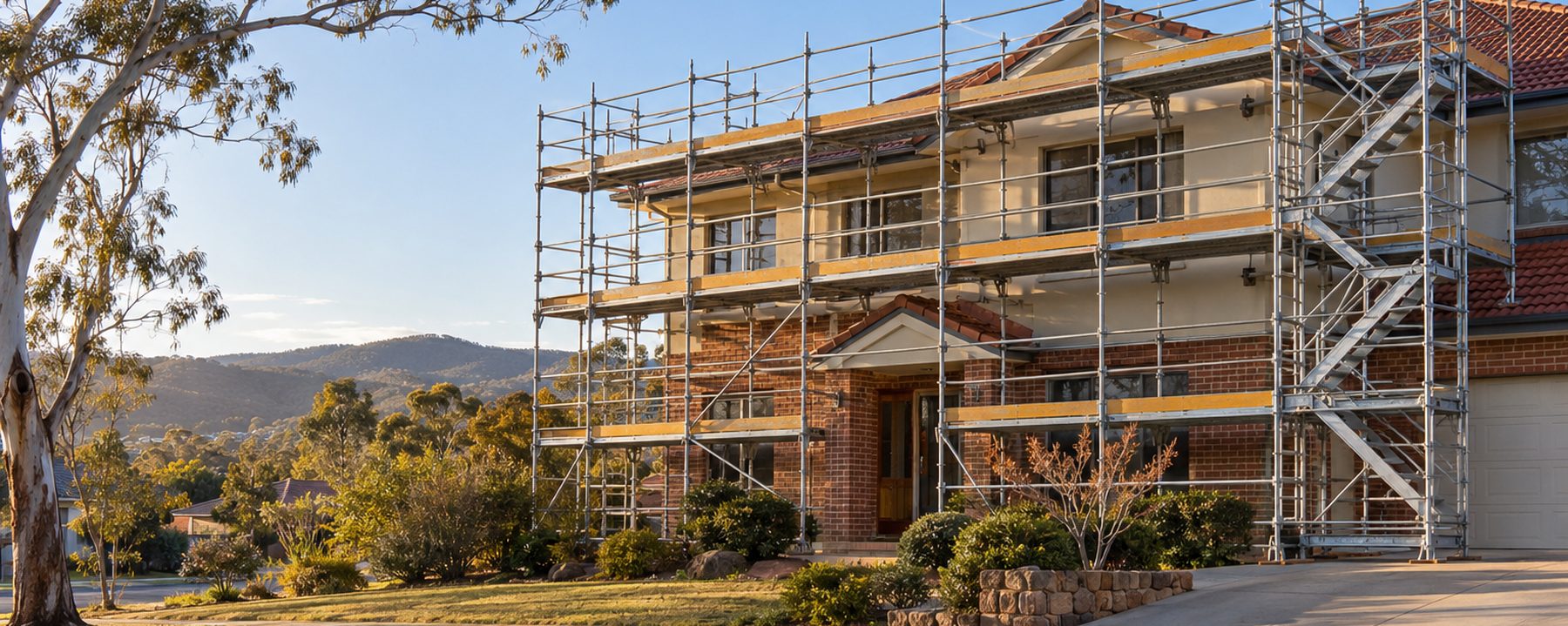
Scaffolding hire in Canberra for houses, renovations and commercial sites.
Hire, erection and dismantling for painters, roofers, builders and owners, from single storey houses to apartment facades, passed to licensed local scaffolders.
Above 4 metres the scaffolder needs a high risk work licence. Under it, the job often needs none. Either way you should know who is erecting the scaffold and what you will be handed at the end.
Tell us what is going up and where
The suburb, how many storeys the work reaches, what the scaffold is for and when you need it: a re-roof on a two storey house in Gungahlin, a repaint of a brick veneer in Belconnen, gutters on a single storey in Weston Creek, a facade job on an apartment block in North Canberra. A photo of the building from the street, taken from the front gate, is enough to begin with. If there is a nature strip, a driveway slope or an overhead line near the wall, say so.
If a roofer, painter or builder is already booked, give their start date. A trade that arrives before the scaffold is up loses days, and the lead time for any approval on the nature strip is part of that.
Request a quote
Brick and tile houses, wide verges and a 4 metre line that decides who may build the scaffold.
The Australian Bureau of Statistics counted 454,000 usual residents in the ACT at the 2021 Census, with separate houses making up 63.2 per cent of dwellings and flats or apartments 19.4 per cent. Much of the scaffold work in a housing market like that is likely to be domestic: re-roofing, repainting, gutters and eaves.
The rule that matters first is height. In the ACT, erecting, altering or dismantling a scaffold from which a person or object could fall more than 4 metres needs a high risk work licence, in basic, intermediate or advanced scaffolding. Access Canberra issues the licence and WorkSafe ACT enforces work health and safety. A single storey eave job often sits under that line and a two storey job often does not, which is why the first question on the form is how high the work is.
The rest is practical. The scaffold needs somewhere to stand, sometimes the nature strip, which the ACT treats as public land with its own approval step. It needs clear air around overhead lines. And it needs to be inspected and handed over properly, because a tag, a recent inspection and a written confirmation that construction is complete are what tell a roofer it is safe to step onto the deck. The pages here cover the trade and the rules in plain words.
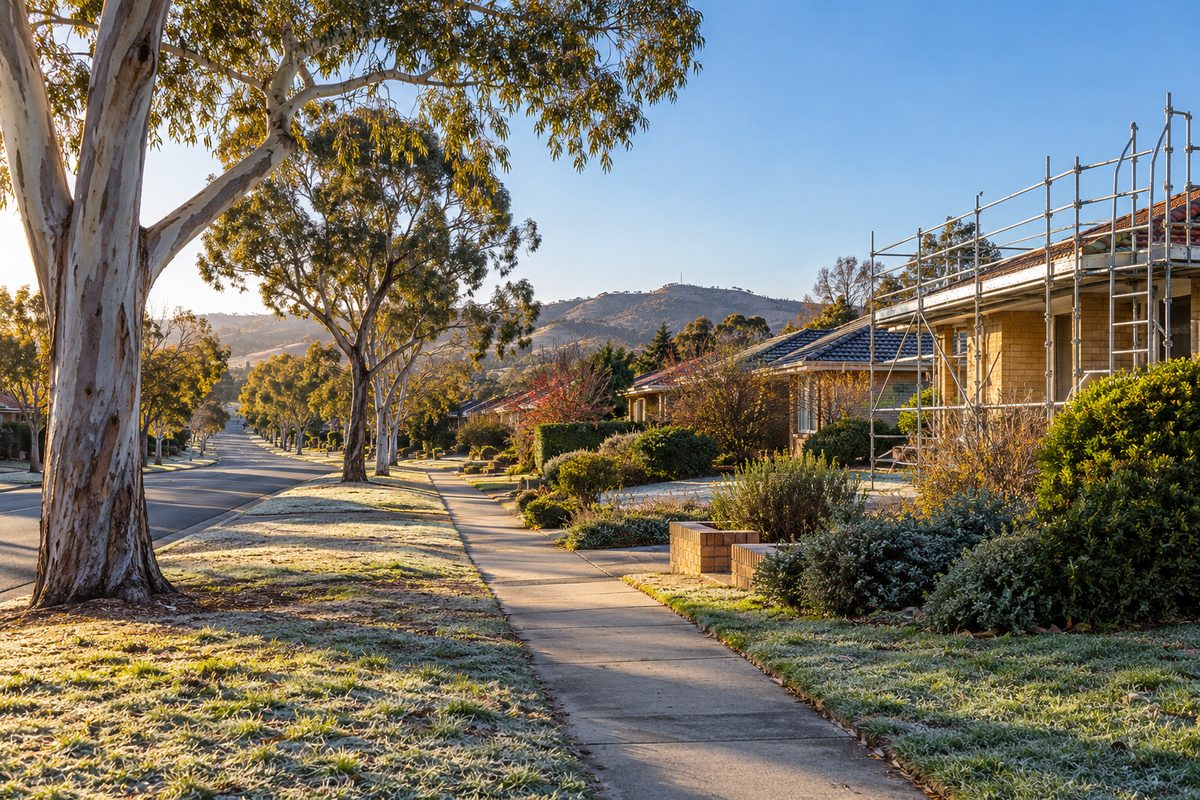
Eight things to settle before a scaffold goes up
Most of the cost surprises and most of the safety problems come from one of these being left until the day the truck arrives.
- How high is the workMeasure where the person will stand, not the roof ridge. The 4 metre line is about the fall from the platform or the structure, and a second storey eave on a house with a high ceiling can sit either side of it.
- Who is erecting itAsk for the scaffolder's high risk work licence number and class. Most local scaffolders do not publish licence numbers, so the request is normal and a good one will answer it without fuss.
- Where does it standOn your block, or partly on the nature strip or footpath. Scaffolding or materials on public unleased land is likely to need approval, and the Public Land Use Team asks for 14 working days before work starts.
- What is overheadLook at the street side of the house for service lines. Evoenergy's figure for metallic scaffold is 4 metres from overhead lines, and work inside that distance needs an accredited erector.
- How long will the trade takeA re-roof that slips a week on a wet or frosty spell holds the scaffold up a week. Ask for the base hire period, the weekly extension rate and what happens when the job runs over.
- What is the building made ofOlder eaves and roofing may need an assessment before anything is disturbed, and a registered heritage place needs a check before anything is fixed to it. Both can move the start date.
- What do you get at handoverA scaffold tag, an inspection by a competent person and written confirmation that construction is complete. Ask for a handover certificate on any scaffold, not just the tall ones.
- Who else is working on itPainters, roofers and gutter fitters working from the scaffold need a safe work method statement of their own. The scaffolder's job ends at the scaffold, not at the trades using it.
Scaffolding services in Canberra and Queanbeyan
Each page explains what the work involves, which rules apply to it, and what tends to move the price.
Scaffolding hire
Hiring a scaffold in Canberra for a week or a season: what the hire covers, who erects it and what happens when the job runs over.
Read more →Residential scaffolding
Scaffolding for re-roofing, painting, gutters and renovations on Canberra houses, from single storey brick veneer to two storeys.
Read more →Commercial scaffolding
Facade, access and edge scaffolding for apartment, office and public buildings, with hoists, gantries and walkways.
Read more →Roof edge protection & mobile scaffold
Edge protection for roof work and mobile towers for work under four metres, and when a licence is and is not needed.
Read more →Scaffold erection & dismantling
How a scaffold goes up and comes down, who must be licensed to do it and what you should see on handover.
Read more →What it costs
What moves the price of a scaffold in Canberra, from height and access to hire length and approvals, and what a quote should itemise.
Read more →Why scaffolding here is its own job
Four things about Canberra shape what goes up, who may put it up and how long it stays.
The housing. The ACT Planning district profiles show how different the districts are. Belconnen is the largest, with 98,740 people in 2017, and 71 per cent of its dwellings are low density. Tuggeranong had 85,422 people and 82 per cent low density. Weston Creek is 81 per cent low density. Further in, Woden Valley has 17 per cent higher density housing, North Canberra 41 per cent and South Canberra 45 per cent. Low density districts tend to mean house scaffolds, while higher density areas tend to mean larger facade jobs.
The growth. Gungahlin had 75,516 people in 2017 and is projected to reach 100,200 by 2041, with 27 per cent medium density housing, the highest of any district. Molonglo Valley had 5,847 people in 2017 and is projected to reach 51,400, with 36 per cent higher density housing. On a construction project of $250,000 or more, WorkSafe ACT says the principal contractor carries duties under the WHS Act.
The weather. At Canberra Airport the Bureau of Meteorology records a mean annual rainfall of 636.7 mm over 2008 to 2026, a mean January maximum of 30.0 C, a mean July maximum of 12.9 C and a mean July minimum of 0.1 C. The ACT Climate Guide says frost risk has typically ended by the last week of October. Cold mornings and short winter days slow work, and a slower job means a longer hire.
The public land. The verge between the kerb and the front fence is Territory property. Putting a scaffold, a skip or stacked materials on it is a public land question as well as a building one, and the process is run by Transport Canberra and City Services, not by the scaffolder. Queanbeyan, across the border, sits under a different regulator and a different council, which the border page sets out.
Practical consequence: the quote that ignores the nature strip, the power lines and the handover paperwork is the one most likely to come back with extra charges.
Towns and districts covered:
What happens when you hire a scaffold
Six steps. The first three happen before anything is delivered, and step three is where most delays are made.
Photos, suburb and height
What the scaffold is for, how high the work is, which sides of the building it needs and what is around it. A photo from the street and a rough sketch of the access to the back give the scaffolder something to work from.
Quote and terms
A written quote naming the scaffold type, the area, the base hire period, the weekly extension rate, delivery and collection, and any certificate. Ask what the scaffolder does if the trade runs over.
Approvals and clearances
Nature strip or footpath use goes to the Public Land Use Team. Overhead lines go to Evoenergy if the 4 metre distance cannot be kept. A registered heritage place gets a check before anything is fixed to it.
Erection
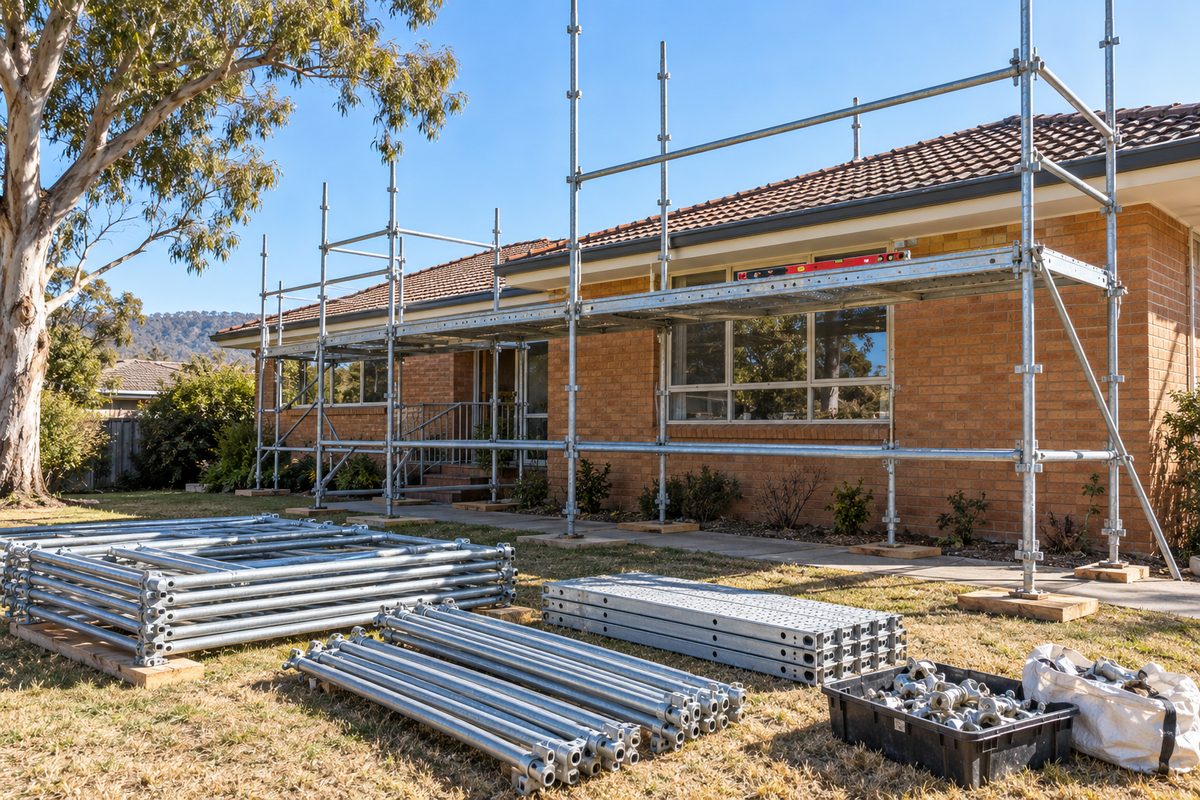
Sole boards or base plates go down on firm ground, standards and ledgers go up lift by lift, and ties fix the scaffold to the building. Above 4 metres, a licensed person erects it.
Handover and inspection
A competent person inspects and confirms in writing that construction is complete. A tag goes on the scaffold. Inspections repeat at intervals not exceeding 30 days, and after a severe storm or any repair.
Dismantling
When the trades finish, the scaffold comes down in reverse and is collected. Tell the scaffolder the day the work ends, because the terms on when hire stops differ by contractor. Ask when you book.
Two regulators, one licence trigger, one public land process
In the ACT, Access Canberra issues high risk work licences and WorkSafe ACT enforces the Work Health and Safety Act 2011. The licence classes are Basic scaffolding (SB), Intermediate scaffolding (SI) and Advanced scaffolding (SA). Scaffolding work means erecting, altering or dismantling a temporary structure from which a person or object could fall more than 4 metres from the platform or the structure. Under 4 metres a licence is generally not required, though a scaffold can still need a licensed scaffolder where another fall hazard exists.
WorkSafe ACT says the Act gives duties to designers, scaffolding contractors, workers and principal contractors on projects of $250,000 or more. Working decks need guardrails, mid-rails and toe boards, people need training and supervision, and trades working on or near scaffolds need a safe work method statement. Falls from height are notifiable incidents and are reported to WorkSafe ACT on 13 22 81.
The nature strip is separate. Approval for works on or using public unleased land runs through the Public Unleased Land Act 2013 and the Public Land Use Team, and across the border in Queanbeyan the equivalent step sits with the council under the Roads Act 1993.
Footpaths, nature strips and power lines · Inspections and handover certificates
What a scaffolder cannot do
A scaffolder cannot approve your use of the nature strip, because that belongs to the Public Land Use Team. A scaffolder cannot move an overhead line, switch it off or authorise work inside the Evoenergy distance without accreditation. A scaffolder cannot tell you whether your block is on the ACT Heritage Register, decide how your roofer works safely from the deck, or make an unlicensed person's erection legal. Those belong to the Territory, Evoenergy, the Heritage Council and the trade using the scaffold. This site cannot do any of them either: it is a referral service and carries out no scaffold work.
Check the current rules before you rely on this
This page summarises how scaffolding is licensed, inspected and approved in the ACT and where Evoenergy and the public land process come in. It describes the rules in general terms as they stood in October 2026. Standards, forms, thresholds and fines change.
The authoritative sources are Access Canberra, high risk work licences, WorkSafe ACT, high risk licensing, WorkSafe ACT, scaffolding, Safe Work Australia, guide to scaffold inspection and maintenance, Evoenergy, scaffolding near overhead powerlines and ABLIS, approval for works on or using public unleased land (ACT). Where anything here differs from those sources, they are right and we are not.
We are not scaffolders, engineers, regulators or lawyers. For what applies to your job, ask the scaffolding contractor, WorkSafe ACT (13 22 81) or, for work on public land, the ACT Government Public Land Use Team.
Accurate at the time of writing, October 2026. Always check the source before relying on it.
What a scaffolding quote should itemise
Scaffolding is priced on the job, not off a list. This site does not publish prices, because height, area, type, access and hire length move the number a long way and a single figure would be wrong for most houses. What you can do is make sure each quote spells out the same things, so the quotes can be compared.
| Line | What to ask |
|---|---|
| Scaffold type and area | Which sides of the building, how many lifts, and whether it is modular, tube and coupler or a mobile tower. The area covered sets the base. |
| Height | The working platform height, not the roof height. It decides whether a licensed scaffolder must erect it. |
| Base hire period | How long the price covers. Terms vary by contractor, so ask for it in writing. |
| Weekly extension | What each extra week costs once the base period is used, and how you tell the scaffolder the job is finished. |
| Delivery and collection | Whether it is included, and whether a steep driveway or a narrow side path changes it. |
| Certificates | Whether a handover certificate or engineering sign-off is included or charged separately. |
| Approvals | Who applies for any nature strip approval, and whether its fee and lead time are in the price. Ask the Public Land Use Team for the current figure. |
| Extras | Edge protection, stair access, covered walkways, shade cloth or sheeting, and any assessment needed before older roofing or eaves are disturbed. |
When you compare quotes, check that each names the licence number of whoever erects it, states the base period and the extension rate, and says what happens if frost or rain holds the trades up.
Things Canberra home owners and builders ask
Do scaffolders need a licence in Canberra?
For scaffolding work where a person or object could fall more than 4 metres from the platform or the structure, yes. Erecting, altering or dismantling that scaffold needs an ACT high risk work licence in basic, intermediate or advanced scaffolding, issued through Access Canberra. Under 4 metres a licence is generally not required, though another fall hazard, such as an excavation beside the scaffold, can change that. Ask the scaffolder for the licence number and class.
Is this site a scaffolding company?
No. It is a referral service. Your enquiry is passed to a local licensed scaffolder who supplies, erects and dismantles the scaffold. The site does not own scaffolds, carry out work, quote or sign contracts, and nothing on it is a quote. It explains the rules and the questions worth asking, then puts you in touch with someone who can do the job.
Do I need approval to put scaffolding on the nature strip or footpath?
Probably. In the ACT, works on or using public unleased land go through the Public Unleased Land Act 2013 process run by the Public Land Use Team, and the approval page asks for 14 working days before work starts. No ACT page found names scaffolding specifically, so confirm with the team on 02 6205 8794 before the scaffold or any materials go on the verge.
How long can I hire scaffolding for?
There is no official answer. Terms vary by contractor, so ask for the base hire period, the weekly extension rate and what happens when the job runs over. Canberra work can run long when frosty mornings and short winter days slow the trades, so a roofer or painter should say how much slack the schedule has before you agree the base period.
What should I see when the scaffold is handed over?
A scaffold tag on the scaffold, a recent inspection by a competent person and a written confirmation that construction is complete. WorkSafe ACT names a written handover certificate for suspended scaffolds, and Safe Work Australia's guide gives an example certificate for others, so ask for one on any scaffold. WorkSafe ACT's alerts say scaffolds are inspected at intervals not exceeding 30 days.
How close can a scaffold go to overhead power lines?
Evoenergy says to keep 4 metres from overhead lines for metallic scaffold. If that cannot be kept, contact Evoenergy before work starts, and inside that distance the erector must be Evoenergy-accredited. Treat every line as energised. Evoenergy's emergency number is 13 10 93 and general enquiries are on 13 23 86. Tell the scaffolder about any lines when you enquire.
What moves the price of scaffolding in Canberra?
Height, the area covered, the type of scaffold, how hard the site is to reach, how long it stays up, delivery, any engineering or handover certificate and whether the nature strip is involved. This site does not quote prices, because one figure would be wrong for most jobs. The cost guide explains each driver and what a written quote should itemise.
Can a Queanbeyan scaffolder work in Canberra?
Generally yes. Access Canberra says a high risk work licence issued by another state or territory is recognised in the ACT, and SafeWork NSW says the same about interstate licences in NSW. The classes and the 4 metre rule are the same on both sides. The regulator and the permit authority differ, so check the licence and who issued it.
Send a few photos and a suburb
The suburb, how high the work is, what the scaffold is for and a photo of the building from the street. Say if there is a nature strip or a power line near the wall. That is a good start for the scaffolder to work from.