Why erection and dismantling are the licensed parts
A scaffold is not dangerous because of the steel. It is dangerous because of how it is built, how it is fixed to the ground and the building, and what happens to it when the wind comes up or someone takes a piece out. That is why the licence attaches to the erecting, the altering and the dismantling. In the ACT, a high risk work licence is needed to erect, alter or dismantle a scaffold from which a person or object could fall more than 4 metres. We are a referral service: we pass your enquiry to local licensed scaffolders and do not own scaffolds or do the work.
The rest of this page describes the sequence, the licence classes, and the paperwork you should expect to see at the end. It is general. The scaffolder decides the design for your building, and a plan for a complex scaffold is a competent person's job.
How a scaffold goes up
- Site check. The scaffolder looks at the ground, the access, overhead lines, the nature strip and the building. They decide the type, the number of lifts and where the ties can go. Ask about overhead lines at this stage.
- Delivery and layout. The frames, ledgers, decks and couplers arrive and are laid out on the lawn or the drive, close to where they will be used. The base line is marked out.
- Base. The base of each standard sits on a base plate, and each base plate sits on a timber sole board that spreads the load into the ground. The base is levelled. Missing sole plates were among the problems found in the 2017 WorkSafe ACT audit, so look at them yourself.
- First lift. Standards go up, ledgers and transoms are fixed between them at the right heights, a level is checked on the ledgers, and bracing goes in. The first lift sets the geometry for everything above it.
- Ties. As the scaffold rises it is tied back to the building at points the scaffolder chooses, so it cannot lean away from the wall. The fixing method depends on the wall. Ask how holes will be made good.
- Decks and rails. Working decks go in, with guardrails, mid-rails and toe boards, as WorkSafe ACT's scaffolding page requires, plus ladder or stair access.
- Handover. A competent person inspects the finished scaffold and, in practice, gives you written confirmation and a tag before anyone uses it.
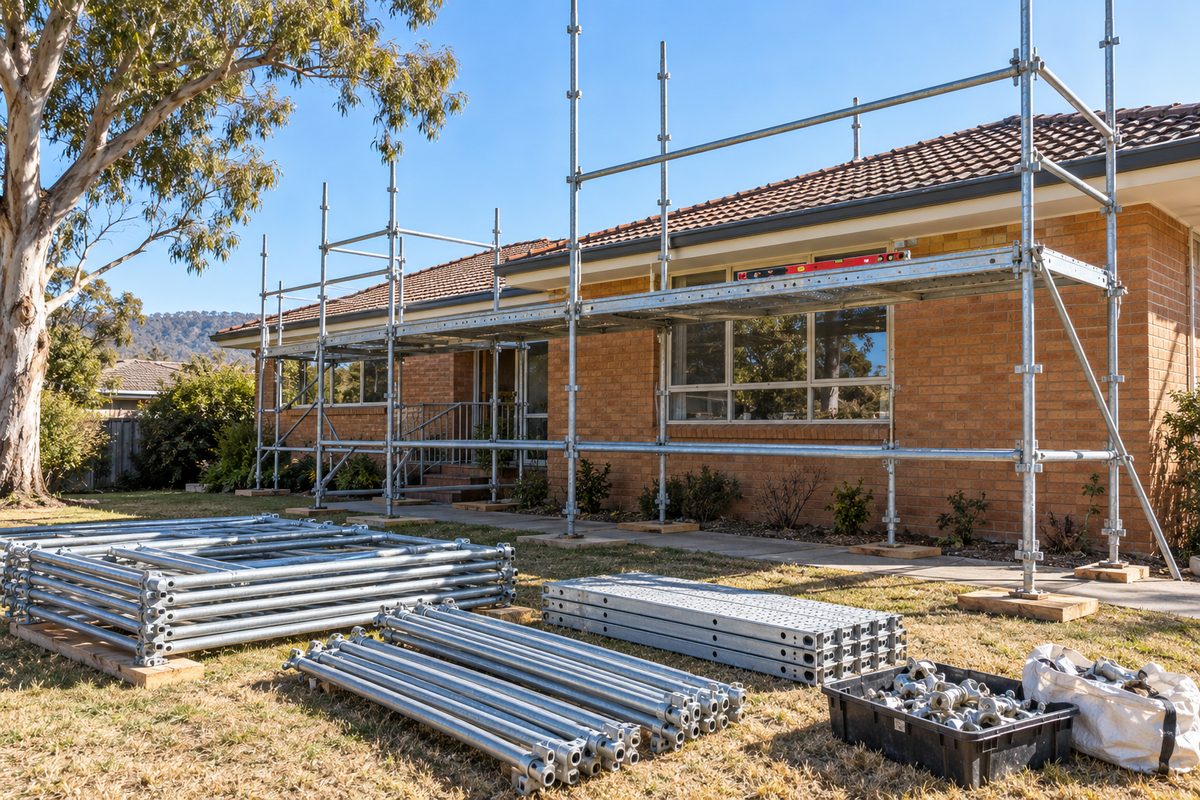
Allow for the time this takes. A base that is not level, a wall that cannot take a tie where the scaffolder wants one, or a delivery that cannot reach the block can each add a visit, so mention steep drives, narrow side setbacks and soft ground when you ask for the quote. While it is incomplete, it must be signed. WorkSafe ACT's alerts say an incomplete scaffold must be signed "Scaffold incomplete - Do not use". If you see a scaffold with a half-built bay and no sign, that is worth a question to the scaffolder before any trade climbs it.
Which licence covers which scaffold
Access Canberra lists the licence classes as Basic scaffolding (SB), Intermediate scaffolding (SI) and Advanced scaffolding (SA). Anyone who plans to do work that is a class of high risk work must hold the licence, with exemptions for trainees supervised by a licensed person and applicants awaiting a decision. The ACT pages name the classes but do not list scopes, so the table below shows them as SafeWork NSW describes them, since NSW uses the same national class names and codes.
| Class | What it covers, as SafeWork NSW describes it | Typical use |
|---|---|---|
| Basic scaffolding (SB) | Modular and prefabricated scaffolds, cantilevered materials hoists up to 500 kg, bracket scaffolds | Modular and prefabricated scaffolds |
| Intermediate scaffolding (SI) | Adds tube and coupler scaffolds (including covered ways and gantries), cantilevered and spurred scaffolds, perimeter safety screens and shutters, mast climbers | Tube and coupler, gantries, screens |
| Advanced scaffolding (SA) | Adds cantilevered hoists, hung scaffolds and suspended scaffolds | Hung or suspended work |
Which licence a particular scaffold needs is the scaffolder's call, and the erector should be able to say. Ask for the licence number and the class, and check it. A licence from another state or territory is recognised in the ACT, which matters in Queanbeyan, so a NSW-licensed crew may work on either side of the border. Local scaffolders are concentrated in Hume, Fyshwick and Queanbeyan, and most do not publish licence numbers, so you usually need to ask. The licensing page has the regulator contacts, and the licence guide gives the plain-language version.
Standards, plans and registered plant
WorkSafe ACT says scaffolding must meet AS 1576. The AS 1576 series covers general requirements, couplers, prefabricated and tube-and-coupler scaffolding and suspended scaffolding among other parts, and we do not give edition years because we could not confirm which are current. Safe Work Australia's guide says a scaffolding plan should be prepared by a competent person for more complex scaffolds, kept at the workplace, with a site layout plan and elevations and sections. That is guidance, not a verified ACT duty, but it is reasonable to ask for a plan on a tall or irregular scaffold. For prefabricated scaffolds registered as plant, the guide also mentions records of commissioning, inspection, maintenance and dismantling.
Inspection, tags and handover
Handover is the moment the scaffold goes from the scaffolder's hands to the people using it. Safe Work Australia's guide says a competent person must give written confirmation that construction is complete before a high-risk scaffold is used. Its example certificate covers the certificate number, erector and client details, the drawings and intended use, the duty classification, the number of working decks, the top platform height, the bay types, a handover inspection statement with the inspector's name, signature, licence number, date and time, client acceptance, and an attached inspection checklist.
WorkSafe ACT names a written handover certificate for suspended scaffolds, and Safe Work Australia's guide gives an example certificate, so ask for one on any scaffold. After handover, WorkSafe ACT alerts say the scaffold should be inspected after events such as a severe storm, before use after repairs and at intervals not exceeding 30 days, by a competent person, and a scaffold tag should be present and show a recent inspection. Problems WorkSafe ACT has listed include a tag that had not been inspected within 30 days and no tag at all. See the inspections and handover page.
How a scaffold comes down
Dismantling is erection in reverse, and it is licensed in the same way. The decks and rails come off bay by bay, the ties are removed as the scaffold lowers and not before, and the base is last. In practice a crew works from the top, passes components down by hand or by line, and keeps people clear of the area below. A change to the scaffold during the job counts as alteration, and alteration needs the same licence over 4 metres. Do not let a trade remove a rail, a tie or a board to get a ladder or a bucket through. Ask the scaffolder to do it, and to re-inspect afterwards.
Power lines apply at both ends. Evoenergy says to keep 4 metres from overhead lines for metallic scaffold, to contact Evoenergy before work starts if that cannot be done, and that inside that distance the erector must be Evoenergy-accredited. A safe work method statement is required, and lines are to be treated as energised. Footpaths and nature strips need to be considered before the truck arrives; the footpaths page explains the ACT process, which is likely to need approval. For hire terms see the hire page.
What an erection page cannot do
It cannot design your scaffold, check your ground or confirm that a particular crew holds the right licence. It does not say whether an ACT rule requires a handover certificate or a scaffold plan on an ordinary scaffold, because we could not verify that. It cannot replace the inspection by a competent person. Ask the scaffolder for their licence number and class, the plan if the scaffold is complex, the handover certificate, the tag and the inspection schedule, and keep them until the scaffold is down.
Check the current rules before you rely on this
This page describes how scaffolds are erected, inspected and dismantled in the ACT and who must be licensed. It describes the rules in general terms as they stood in October 2026. Standards, forms, thresholds and fines change.
The authoritative sources are Access Canberra, high risk work licences, WorkSafe ACT, scaffolding, Safe Work Australia, guide to scaffold inspection and maintenance, Safe Work Australia, guide to scaffolds and scaffolding work, SafeWork NSW, scaffolding licences and Evoenergy, scaffolding near overhead powerlines. Where anything here differs from those sources, they are right and we are not.
We are not scaffolders, engineers, regulators or lawyers. For what applies to your job, ask the scaffolding contractor, WorkSafe ACT (13 22 81) or, for work on public land, the ACT Government Public Land Use Team.
Accurate at the time of writing, October 2026. Always check the source before relying on it.