A district of low density housing
ACT Planning's district profiles, set out in a table on the Gungahlin profile page alongside the other districts, give Tuggeranong a population of 85,422 in 2017 and a low density share of 82 per cent. It is the number that shapes the scaffolding work. Where more than eight in ten dwellings are low density, many jobs are likely to be on a house, so the questions below start from that.
The profile does not give the age of the housing, the condition of roofs or the number of renovations under way, and we will not guess at them. What the 82 per cent does allow us to say is how a typical job here is built. It is likely a house, with a roof, gutters, walls and eaves that a trade needs to reach. The questions below are the ones that follow from that.
One storey or two: where the licence line falls
In the ACT, a high risk work licence is needed for scaffolding work where a person or object could fall more than 4 metres from the platform or the structure. That wording comes from the model Work Health and Safety Regulations, which we read in the Commonwealth compilation, and Access Canberra lists the three classes: Basic scaffolding (SB), Intermediate scaffolding (SI) and Advanced scaffolding (SA). WorkSafe ACT's alerts say scaffolding over 4 metres may be erected, altered or dismantled only by a licensed, competent person.
For a Tuggeranong house, that line may fall between the storeys. A scaffold for a single storey eave can be under it, and the second storey wall of a two storey house may be over it. The scaffolder decides after measuring. If your house has a high pitched roof, a sloping block or a raised floor at the back, the fall can be more than it looks from the street. Ask the scaffolder to tell you the height they have measured, which class of licence the erector holds and the licence number. A licence from another state or territory is recognised in the ACT, per Access Canberra, so what to check is the licence itself and the authority that issued it.
Roof work and edge protection
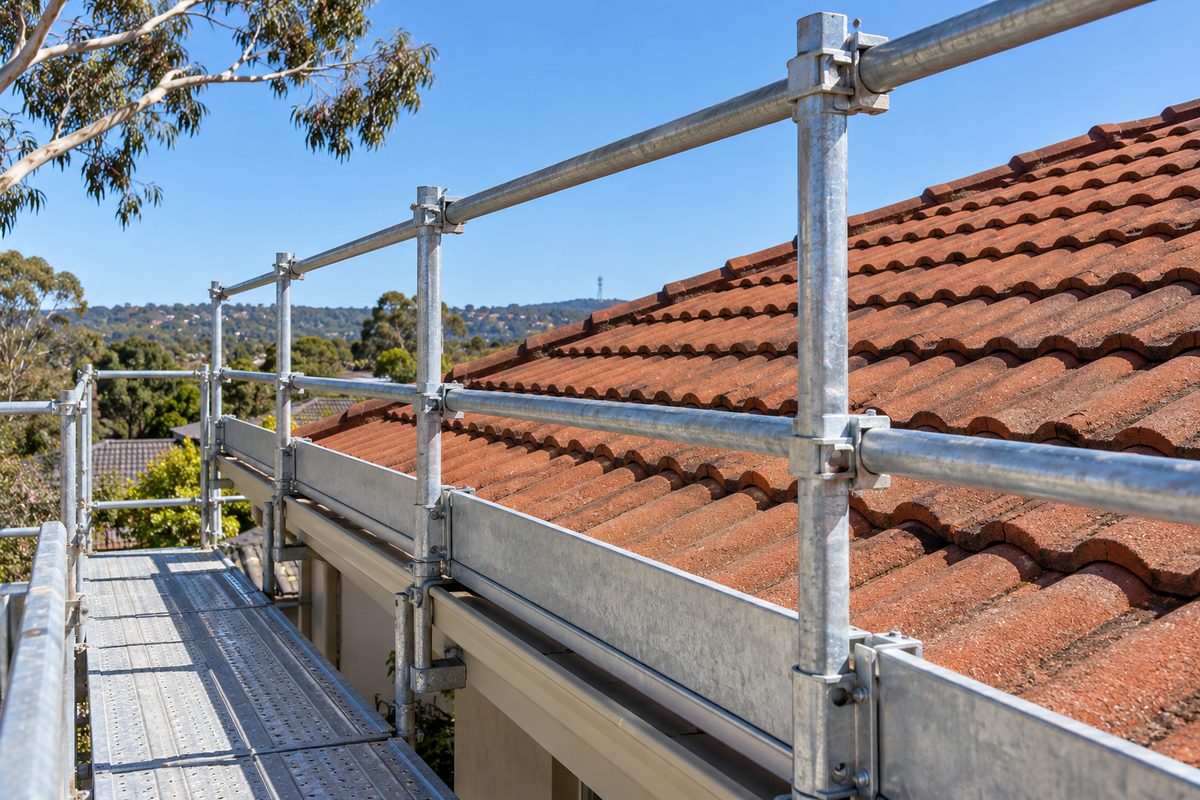
A likely reason a low density house needs a scaffold is the roof. Re-roofing, gutter replacement, fascia repair and repainting all need someone working at the edge. For that work a scaffold is usually set up with edge protection at the eave, so that a person on the roof or on the top platform has a guardrail and mid-rail between them and the drop. The edge protection page explains this in detail, including the point that work under 4 metres often needs no licence.
Where there is an older roof, ask who will assess it before anyone disturbs it. Asbestos assessment before disturbing older roofing or eaves is one of the cost drivers we list in the cost guide, and it is a question to settle before the scaffold goes up, not after. We do not have data on the age of Tuggeranong roofs, so this applies to any older house, not to a particular street.
Wide blocks, nature strips and what is on them
A scaffold at the front of a house may sit near the boundary, and deliveries or skips may use the nature strip. In the ACT, nature strips are Territory property, and ABLIS describes approval for works on or using public unleased land, under the Public Unleased Land Act 2013. The Public Land Use Team (02 6205 8794) says to apply fourteen working days before starting, and notes that a temporary traffic management plan may be needed.
The related permit page, for a Public Unleased Land Permit, covers activities that exclude the public from the land, and its listed example is a skip on a footpath. It does not name scaffolding. So the careful position is that scaffolding or materials on a nature strip or footpath is likely to need approval, and you should confirm with the Public Land Use Team. If your scaffold can stand entirely on your own block, that question is easier. If it cannot, build the lead time into the booking. The footpath guide covers the process.
Overhead lines on residential streets
Some suburban streets have overhead lines running along or across the boundary. We have no count for Tuggeranong, so we do not say how many, but we do know what Evoenergy asks. Its guidance on scaffolding near overhead powerlines gives a 4 metre approach distance for metallic scaffold near overhead lines. If it cannot be kept, contact Evoenergy before work starts (13 23 86 for general enquiries, 13 10 93 for emergencies). Inside that distance, the erector must be Evoenergy-accredited, and a safe work method statement is required. WorkSafe ACT's own scaffolding page gives 4 metres for metal and 1.5 metres for timber, and we cite the Evoenergy figures for network clearance. Look up before you book, and tell the scaffolder what you see.
Frost and the cold months
We have no weather record specific to Tuggeranong, so the figures here are from Canberra Airport. The Bureau of Meteorology gives a mean minimum of 0.1 degrees Celsius in July, a mean maximum of 12.9, and 636.7 millimetres of rain a year. The ACT climate guide says the frost risk has typically ended by the last week of October. For a Tuggeranong re-roof that runs through winter, this means early starts are cold, short days limit the hours and the job can run longer than the same job in summer. The hire length guide explains why this matters for the base period and the weekly extension rate.
What to ask the scaffolder
| Question | Why it applies in a district of houses |
|---|---|
| How high is the work, measured? | Eaves on one storey are often under the 4 metre line; a two storey wall is often over it. |
| Which class of licence will the erector hold? | SB covers modular and prefabricated scaffolds as the NSW regulator describes it; SI adds tube and coupler. No ACT page lists scopes. |
| Is there edge protection at the roof? | Roof work from the scaffold needs a guardrail and mid-rail at the edge. |
| Does any part sit on the nature strip? | If it does, it is likely to need approval; confirm with the Public Land Use Team. |
| Where is the nearest overhead line? | Metallic scaffold has a 4 metre approach distance from overhead lines, per Evoenergy. |
| Who inspects and when? | A competent person inspects before use, after a storm and at intervals not exceeding 30 days. |
Once those are answered, the rest is logistics: access for the truck, the dates, and the dismantle notice. The residential scaffolding page sets out the usual order of work, and the inspections guide says what to ask to see at handover.
Booking from Tuggeranong
Tell us the suburb, the number of storeys, the use of the scaffold and the dates, and whether anyone has looked at the roof. A photo from the street shows the nature strip and any overhead lines, which saves a site visit. Local scaffolders are concentrated in Hume, Fyshwick and Queanbeyan, so a Tuggeranong job may involve a drive in, and the quote should say whether travel is included.
What this page cannot tell you
It cannot say how old the houses in your street are, what is under the roof or what the ground is like at your front boundary. The district figures are population and dwelling density from ACT Planning, not building age or condition. It cannot confirm that your scaffold needs a licensed erector, or that your nature strip needs approval, because both depend on the particular job. It does not give prices. For the current rules on licences and on public land, ask Access Canberra, WorkSafe ACT and the Public Land Use Team, and ask the scaffolder to explain their plan in writing.
Check the current rules before you rely on this
This page describes Tuggeranong, its low density housing and the licensing, public land and power line rules that apply to scaffolding on a low density house there. It describes the rules in general terms as they stood in October 2026. Standards, forms, thresholds and fines change.
The authoritative sources are ACT Planning, Gungahlin district profile, Access Canberra, high risk work licences, WorkSafe ACT, scaffolding, ABLIS, approval for works on or using public unleased land (ACT), ABLIS, public unleased land permit (ACT) and Evoenergy, scaffolding near overhead powerlines. Where anything here differs from those sources, they are right and we are not.
We are not scaffolders, engineers, regulators or lawyers. For what applies to your job, ask the scaffolding contractor, WorkSafe ACT (13 22 81) or, for work on public land, the ACT Government Public Land Use Team.
Accurate at the time of writing, October 2026. Always check the source before relying on it.